Belt-Conveyor vs Skip-Hoist Concrete Batching Plants
Oct 16, 2026
Belt-conveyor and skip-hoist systems are the two primary configurations for aggregate feeding in concrete batching plants. They differ systematically in terms of conveying logic, structural layout, capital investment, and operational suitability. Selecting the right configuration is critical, as it directly impacts site compatibility, production efficiency, and the total lifecycle cost of the project. Drawing on Haomei Machinery’s experience in equipment R&D and global project delivery, this guide provides a systematic comparison across four dimensions: production efficiency, cost structure, operation and maintenance (O&M) characteristics, and application suitability.
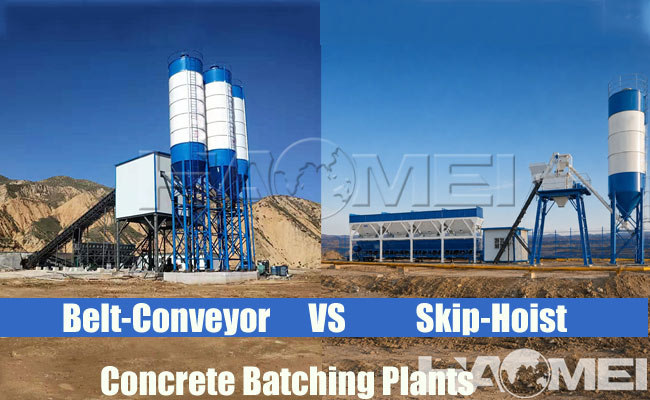
From Production and Conveying Efficiency
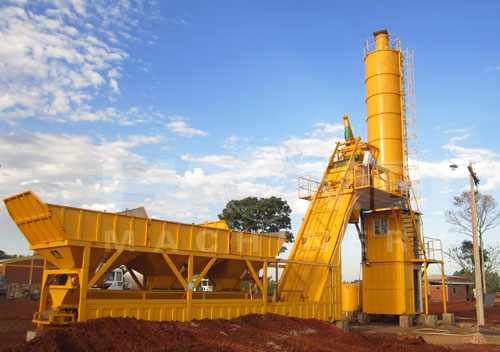
Belt-conveyor systems utilize a continuous, enclosed, skirted conveyor belt—typically operated at an incline of 18°–23°. Aggregates are transported smoothly and at a constant speed, with no impact from drops, resulting in an aggregate degradation (breakage) rate of less than 0.5%. This configuration offers a conveying capacity ranging from 50 to 300 t/h, making it compatible with the full spectrum of medium-to-large concrete batching plants (HZS50 to HZS240). It ensures seamless integration between aggregate feeding, proportioning, and mixing, eliminating idle waiting times. Consequently, the overall capacity utilization rate can reach 85%–90%—approximately 10%–15% higher than that of skip-hoist systems with equivalent capacity.
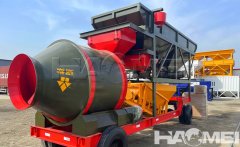
In contrast, skip-hoist systems employ an intermittent feeding method, where a skip (bucket) is pulled by steel cables or chains along a track—often at a steep incline of 60°–90°—before tipping to discharge the material at the top. Due to the cyclical nature of loading, hoisting, and discharging, the conveying efficiency is lower than that of continuous belt systems. Skip-hoist concrete batching plants are primarily used for small-to-medium concrete batching plants (HZS25 to HZS90), with a capacity utilization rate of approximately 70%–80%.
From Costs and Site Footprint:
For a given production capacity, the initial purchase price of a skip-hoist concrete batching plant is 10%–15% lower than that of a belt-conveyor concrete batching plant. This is primarily because the skip-hoist design eliminates the need for long conveyor frames, idler sets, and tensioning mechanisms, resulting in fewer structural components. In terms of site footprint, the core advantage of the skip-hoist (bucket-lift) concrete batching plant lies in its efficient use of vertical space. The feeding system’s horizontal footprint is 35%–50% smaller than that of a belt-conveyor system, leading to an overall site space saving of 20%–30%. Taking the HZS50 concrete batching plant as an example, a belt-conveyor concrete batching plant requires approximately 1,200–1,500 m², whereas a skip-hoist concrete batching plant requires only 900–1,100 m², making the latter better suited for projects with limited space.
From Operation and Maintenance Characteristics:
Both configurations have their respective advantages and disadvantages.
For belt-conveyor systems, wear-prone components include the conveyor belt itself, idlers, belt cleaners, and drive pulleys. Under normal operating conditions, annual maintenance costs are approximately 2%–3% of the equipment’s original value, with a service life of 8–10 years for the belt. In long-term, continuous operation, these systems exhibit an annual failure rate about 40% lower than that of skip-hoist systems, making them ideal for scenarios requiring prolonged, uninterrupted production.
For skip-hoist systems, wear-prone components include wire ropes, sprockets, hopper liners, and guide rails; annual maintenance costs are roughly 3%–4.5% of the equipment’s original value. Wire ropes require periodic tensioning and calibration, and hopper liners must be replaced when worn. However, the structure is simpler, requiring fewer inspection points and placing lower technical demands on maintenance personnel.
From Scenario Adaptability:
Data from Haomei Machinery’s global project deliveries show that for projects in mountainous regions, mining areas, or existing industrial sites undergoing renovation—where the available site width is less than 15 meters—skip-hoist concrete batching plants are chosen in over 85% of cases. Conversely, for long-term commercial concrete batching plants with an annual capacity exceeding 100,000 m³, belt-conveyor concrete batching plants are selected 92% of the time. For instance, a road restoration project in a mountainous area of Southeast Asia, with a site width of only 11 meters, successfully deployed an HZS50 skip-hoist concrete batching plant, saving 38% of the footprint compared to a belt-conveyor alternative of the same capacity. Meanwhile, a commercial batching plant in East Africa utilized an HZS180 belt-conveyor concrete batching plant; it has operated stably for three consecutive years, with per-unit-capacity maintenance costs 18% lower than those of a skip-hoist system of similar scale.
Selecting the right equipment requires a comprehensive assessment of site space, production capacity requirements, and the operational lifecycle. For long-term commercial use and high-capacity projects, a belt conveyor-fed sconcrete batching plant is the preferred choice. Conversely, for small-to-medium-scale projects with limited space or shorter project timelines, a skip-hoist (bucket elevator) concrete batching plant offers superior cost-effectiveness and adaptability.



 (Chat Online)


