Compact Concrete Batching Plant
Sep 21, 2026
The
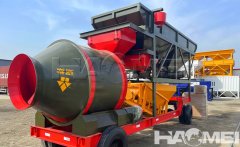
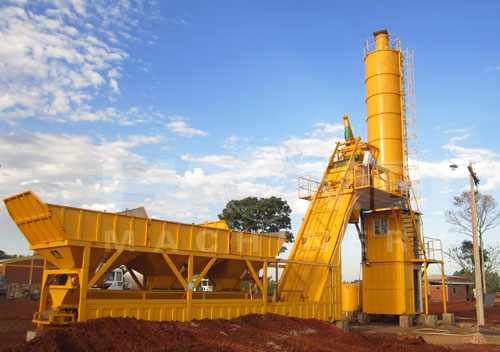
compact concrete batching plant is a specialized product line from Haomei Machinery designed for sites with spatial constraints. Its core design philosophy utilizes a vertical layout and highly modular integration to deliver full ready mix concrete production capabilities within a minimal footprint. The plant compactly arranges four core units—batching, mixing, metering, and control—vertically, eliminating the need for the horizontal conveyor galleries found in traditional concrete batching plants; the total footprint is only 60%–70% of a conventional concrete plant with equivalent capacity.
The compact concrete plants offers production capacities ranging from 25 to 60 m³/h and comes standard with the JS series twin-shaft forced concrete mixer and an independent electronic weighing system. It achieves dynamic aggregate weighing accuracy of ≤±2% and powder/admixture accuracy of ≤±1%. The quality of the finished concrete fully complies with EN 206 and ISO 19720 international standards, enabling stable production across the C10–C50 strength range.
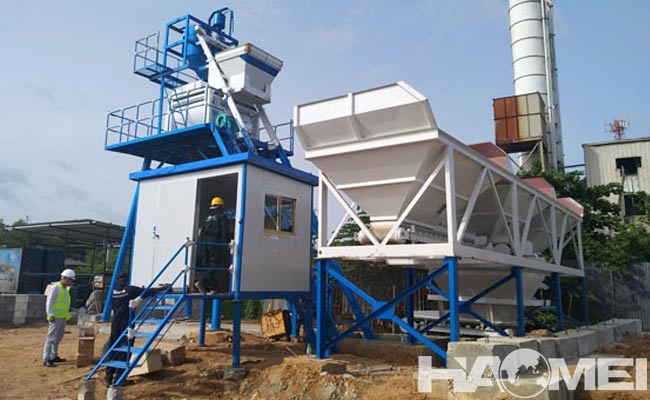
The compact batching plant series comprises three main models, categorized by feeding method and capacity, to suit various site sizes and production requirements.
HZS25: Equipped with the JS500 twin-shaft mixer; features a nominal discharge capacity of 500 L/batch, a standard mixing cycle of 72 seconds, and a theoretical capacity of 25 m³/h. With a main footprint of approximately 8 m × 5 m, it is the smallest model in the series, ideal for temporary construction sites with extremely limited space.
HZS35: Equipped with the JS750 mixer; features a nominal discharge capacity of 750 L/batch, a standard mixing cycle of 65 seconds, and a theoretical capacity of 35 m³/h. With a main footprint of approximately 9 m × 5.5 m, it is the most widely used model in the compact series, offering an optimal balance between footprint and production capacity.
HZS50: Equipped with the JS1000 mixer; features a nominal discharge capacity of 1000 L/batch, a standard mixing cycle of 60 seconds, and a theoretical capacity of 50 m³/h. With a main footprint of approximately 11 m × 7 m, it represents the high-capacity tier of the compact series, capable of meeting the daily supply needs of medium-sized projects.
All three models feature a vertical hopper-fed structure, achieving a stable continuous production rate of 70%–80% and effectively meeting the feeding requirements of non-continuous production scenarios.
Key advantages of compact concrete batching plant including:
- Exceptional Space Efficiency:
The vertical feeding structure eliminates the need for inclined conveyor belts; for the same production capacity, the horizontal footprint is 30%–40% smaller than that of belt-conveyor mixing plants. Taking the
HZS35 model as an example, the main plant occupies less than 50 m², allowing it to fit into space-constrained areas such as urban construction sites or mountainous mining zones. With an overall height of under 12 meters and minimal overhead clearance requirements, the equipment is suitable for height-restricted environments like factory interiors or locations beneath bridges.
- Low Civil Engineering Investment:
The plant’s load is evenly distributed, requiring only a leveled, hardened concrete slab for installation—eliminating the need for heavy reinforced concrete foundations. Civil engineering requirements are reduced by over 35% compared to standard belt-conveyor plants, significantly lowering initial fixed investment costs.
- Rapid Installation:
Over 80% of core components are pre-assembled at the factory. Once disassembled, all parts fit into standard 40HQ containers for transport. On-site work is limited to flange connections and wiring, with commissioning and production startup achievable in just 5–7 days—cutting the construction cycle by nearly 40% compared to traditional plants shipped as loose components.
- Low Operation and Maintenance Costs:
The number of moving parts is reduced by over 40% compared to belt-conveyor systems, eliminating common issues like belt misalignment and idler roller wear; the annual failure rate in dusty, harsh conditions is reduced by approximately 50%. Routine inspections focus only on wire ropes, pulley blocks, and the main mixer's wear parts, with consumable costs reduced by over 20%—making the system ideal for overseas markets with limited professional maintenance capabilities.
Compact concrete mixing plants offer a wide range of applications.
In urban small-scale municipal projects and the renovation or expansion of aging industrial sites—where space within the site boundaries is limited and standard-sized equipment cannot easily access the area—compact batching plants can be installed directly within the construction zone.
For infrastructure projects in mountainous areas, mining zones, or remote villages where transportation is difficult and terrain is complex, the modular design and rapid installation capabilities of compact concrete batch plants make them an ideal solution.
For commercial concrete supply points and small-scale precast component plants serving townships and villages, operational scale is often limited, necessitating concrete production and storage within a restricted footprint; compact mixing plants—with their minimal space requirements and low initial investment—are an ideal match for these needs.
Furthermore, this equipment series supports customization for 380V/415V power systems and comes with standard CE certification, ensuring compatibility with diverse global power grids and regulatory standards, making it a cost-effective choice for small-to-medium-sized concrete production projects overseas.
In my years of industry experience, I have observed that site constraints are often the primary factor influencing equipment selection for small and medium-sized projects. By optimizing space usage,
compact concrete plants lower the barrier to entry and offer greater operational flexibility, driving steadily growing demand in global emerging and localized markets.



 (Chat Online)


