Capacity Of Stationary Concrete Plants HZS Series
Aug 10, 2026
The HZS series stationary concrete batching plant is the mainstream equipment type in the domestic commercial ready-mixed concrete market. The model suffix directly corresponds to the nominal capacity level of the equipment and is a core decision-making basis for project investment and equipment selection. Unlike rough capacity estimation, the capacity specification of the HZS series strictly follows the standard GB/T 10171-2016 "Construction Machinery and Equipment - Concrete Batching Plant (Tower)". The HZS series stationary concrete plants cover a capacity gradient of 25~240 m3/h, which can accurately match different scale engineering and commercial scenarios.
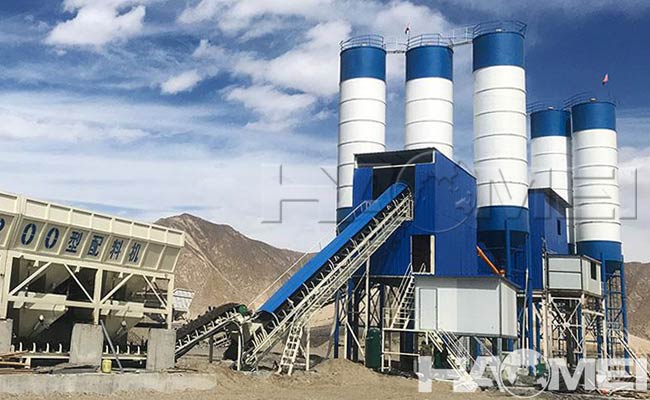
From the perspective of capacity specification logic, the last number in the HZS series name is the theoretical hourly productivity of the equipment, in cubic meters. This value is calculated from the nominal discharge volume of the mixing host and the rated number of cycles per hour. The standard calibration conditions are set as follows: production of ordinary strength grade concrete, continuous uninterrupted operation, sufficient raw material supply, and no waiting time in the unloading process, representing the ideal upper limit of the equipment's capacity. Taking the industry benchmark
HZS180 stationary concrete plant model as an example, it is equipped with a JS3000 twin-shaft forced mixer, with a nominal discharge volume of 3000L and a rated cycle time of 60 times/hour. Multiplying these two values gives a theoretical capacity of 180m3/h. The model name and capacity parameters correspond perfectly.
The HZS series stationary concrete batching plants can be divided into three clear tiers based on capacity scale, with each model's parameters matching mature industry application scenarios.
The small-capacity models cover HZS25 to HZS50, mainly targeting scattered projects in rural towns and small-scale infrastructure projects. Specifically, the HZS25 stationary concrete plant is equipped with a JS500 mixer, with a nominal volume of 500L and a theoretical hourly output of 25m3. Based on 250 operating days per year and 8 hours of operation per day, the theoretical annual capacity is approximately 50,000m3. The
HZS35 stationary concrete plant is equipped with a JS750 mixer, with a theoretical hourly output of 35m3 and an annual capacity of approximately 70,000m3. The HZS50 stationary concrete plant is equipped with a JS1000 mixer, with a theoretical hourly output of 50m3 and an annual capacity of approximately 100,000m3. This equipment models feature a small footprint and low investment threshold, making it suitable for niche markets below the county level.
The medium-capacity models, covering HZS60 to HZS120, is the primary choice for county-level commercial concrete plants and medium-sized infrastructure projects. The HZS60 stationary concrete plant, equipped with a JS1500 main unit, has a nominal volume of 1500L, a theoretical hourly output of 60m3, and an annual theoretical capacity of approximately 120,000m3; the
HZS90 stationary concrete plant, equipped with a JS2000 main unit, has a theoretical hourly output of 90m3 and an annual capacity of approximately 180,000m3; the HZS120 stationary concrete plant, through optimized batching and unloading cycle logic, can theoretically achieve an hourly output of 120m3 and an annual capacity of approximately 240,000m3. This models balance capacity scale and investment cost, representing the widest range of applications across the entire series.
The large-capacity models, covering HZS180 to HZS240, serves the core urban commercial concrete market and national-level large-scale infrastructure projects. The HZS180 stationary concrete plant is currently the benchmark model in the commercial market, with a theoretical hourly output of 180 m3 and an annual theoretical capacity of approximately 360,000 m3. The HZS240 stationary concrete plant, equipped with a JS4000 large-capacity main unit, has a theoretical hourly output of 240 m3 and an annual theoretical capacity of approximately 480,000 m3, and is primarily used in ultra-large-scale linear projects such as high-speed railways, highways, and large-scale water conservancy projects.
In actual production, affected by factors such as aggregate loading intervals, waiting times for tanker unloading, and fluctuations in raw material supply, the stable actual capacity of the stationary concrete plant equipment is typically 80% to 90% of the theoretical capacity. If producing high-strength concrete of C50 and above, or impermeable and frost-resistant special concrete, the actual capacity will further decrease by 10% to 15% because the mixing time needs to be extended from the standard 30 seconds to 45-60 seconds. Therefore, when selecting a model for a project, it is generally recommended to reserve a capacity redundancy of at least 10% to ensure a stable supply for peak demand.
Compared to
mobile concrete plants, stationary concrete plants utilize permanent civil engineering foundations, resulting in less equipment vibration and lower component wear. They can support continuous operation for over 12 hours a day, with an effective operating period of 270-300 days per year, significantly improving long-term production capacity. Combined with large-capacity powder silos and enclosed raw material sheds, downtime due to material shortages can be greatly reduced, further ensuring the continuity and stability of production output. This makes them the optimal choice for long-term commercial operation.



 (Chat Online)


