Central Mix Concrete Plant VS Dry Mix Concrete Plant
Nov 17, 2026
Central mix concrete plants and dry mix concrete plants represent the two primary types of industrial concrete production systems. They differ in whether the mixing process is completed entirely at the concrete plant or finalized during transit. These systems vary systematically in terms of equipment configuration, quality control, transport radius, and investment costs; selecting the right type is critical to operational efficiency and overall project profitability.
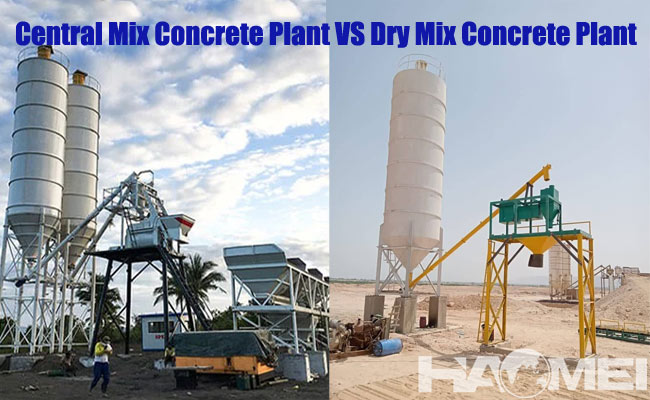
Regarding process principles and core configuration, the fundamental difference lies in where and how the mixing occurs.
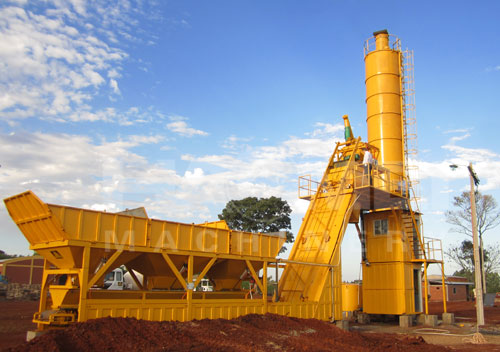
Central mix concrete plants perform the entire mixing process on-site: aggregates, cementitious materials, water, and admixtures are weighed individually and then fed into a twin-shaft forced mixer to produce a homogeneous concrete mix ready for use (with a specific slump). The equipment suite typically includes six major modules: aggregate batching, powder storage and handling, the main mixer, liquid metering, electrical control systems, and environmental protection equipment. Batching accuracy adheres strictly to industry standards: dynamic aggregate weighing error is ≤±2%, while the error for cement, water, and admixtures is ≤±1%. For standard-strength concrete, the mixing time per batch is at least 30 seconds, extending to 45–60 seconds for high-strength concrete, with the coefficient of variation for compressive strength kept within 0.12.
A
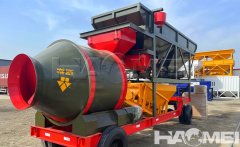
dry-mix concrete batching plant performs only the proportioning and pre-mixing of dry materials; mixing water and liquid admixtures are not added at the plant. Instead, the dry mixture is loaded into a transit mixer, where water is added—either during transport or at the construction site—and the final mixing is achieved through the rotation of the mixer drum. The core mixing unit typically consists of a continuous spiral mixer or a short-cycle twin-shaft mixer, capable of achieving the required uniformity with a dry-mixing duration of just 10–30 seconds per batch. By eliminating the need for high-precision liquid metering systems, main mixer washout piping, and three-stage wastewater treatment facilities, the plant features a streamlined structure. Despite this, the metering accuracy for dry materials remains on par with that of conventional wet-mix (centralized) batching plants: ±2% for aggregates and ±1% for powdered materials.
Regarding production efficiency and transport coverage, each type of concrete plant has its own optimal application range. For a given production capacity, a dry-mix plant can reduce the cycle time by 10%–15%—as it omits the wet-mixing phase and the need to wash out the main mixer—resulting in a slightly higher hourly output compared to a centralized wet-mix plant.
Central mix concrete plants are constrained by the initial setting time of concrete; under normal ambient temperatures, this window is typically 90–120 minutes, limiting the effective transport radius to 15–30 kilometers. Exceeding this range often leads to excessive loss of slump. In contrast, dry-mix materials carry no risk of premature hydration and can be stored in a sealed state for 24–72 hours. This extends the effective transport radius to 50–80 kilometers and improves vehicle turnaround efficiency by approximately 40%, making it well-suited for long-distance or decentralized supply scenarios.
In terms of capital and operational costs, the initial investment for a dry-mix concrete plant is 25%–35% lower than that of a central wet-mix concrete plant, primarily due to the use of smaller-scale mixing units, the omission of liquid metering systems, and simplified environmental protection infrastructure. From a long-term operational perspective, however, centralized wet-mix plants offer superior quality control and more consistent performance. Dry-mix plants require rigorous on-site water-addition management; improper handling can easily lead to deviations in the mix ratio, and tracing the quality of the final product is significantly more challenging.
Regarding application scenarios and selection, central mixing plants are well-suited for projects requiring high performance stability—such as urban commercial concrete supply, large-scale building construction, and municipal infrastructure—and they meet the compliance standards for ready-mix concrete production in most regions. Dry-mix (or dry-batch) plants are better adapted to scenarios with high transportation costs, including infrastructure projects in remote mountainous areas, long-distance linear projects (such as roads or railways), and scattered rural construction sites.
Haomei Machinery offers a comprehensive range of equipment for both types of production processes, with capacities spanning from 25 to 240 cubic meters per hour. We provide customized configurations based on project location, transportation logistics, and quality requirements, complemented by end-to-end services—including site planning, installation and commissioning, and operational training. With over a thousand units delivered globally, we possess extensive experience in successfully implementing solutions across a wide variety of project environments.



 (Chat Online)


