Stationary VS Mobile Concrete Batching Plant Comparison
Nov 11, 2026
Stationary and mobile concrete batching plants represent the two primary categories of concrete mixing equipment, designed to meet distinct operational needs: long-term, stable production versus flexible, mobile deployment. Selecting the appropriate type is critical, as it directly impacts project timelines, capital investment and operational efficiency. Drawing on global project delivery data from Haomei Machinery, the following analysis provides a quantitative comparison across four dimensions: deployment characteristics, production capacity and performance, cost structure, and suitable application scenarios.
Installation Requirements and Timelines
There are significant differences between the two types of equipment regarding deployment requirements and construction timelines.
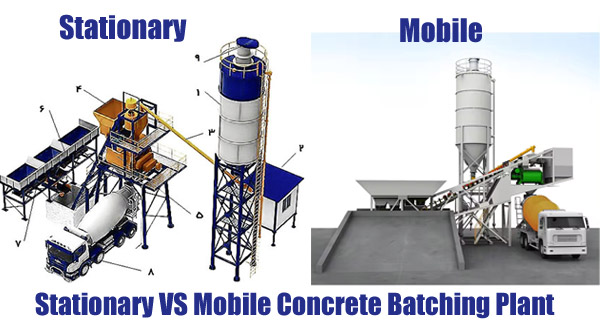
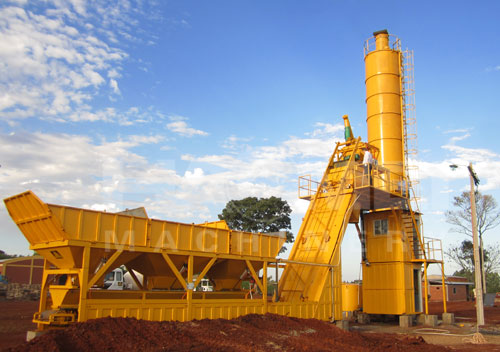
Stationary concrete batching plants—exemplified by the HZS series—require a permanent reinforced concrete foundation (with a strength of at least C30 and a 28-day curing period). Installation and commissioning typically take 20 to 30 days, and the site must support a load-bearing capacity of 180–250 kPa. Once established, these plants serve as fixed production hubs and cannot be relocated as a complete unit.
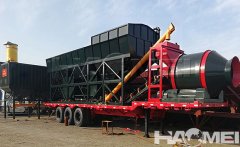
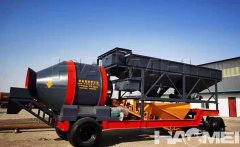
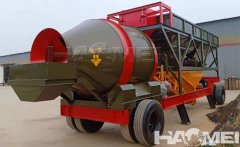
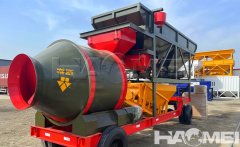
In contrast, mobile concrete batching plants—represented by the YHZS series—feature production units integrated onto a towable chassis. They do not require a reinforced concrete foundation; the site simply needs to be leveled and compacted. With a required load-bearing capacity of 120–150 kPa, standard models can be assembled and commissioned on-site in just 1 to 3 days. Furthermore, they can be dismantled and relocated to new sites within 2 to 4 days, offering the flexibility to move in tandem with project progress. According to industry estimates, mobile concrete batching plants can reduce civil engineering investment by over 70%, making them well-suited for projects with tight construction schedules.
Production Capacity & Operational Stability
In terms of production capacity and operational stability, each type of equipment serves specific use cases.
Stationary concrete batching plants offer a broad capacity range—from the HZS25 to the HZS240 model—with theoretical hourly outputs spanning 25 to 240 cubic meters. Equipped with twin-shaft forced mixers, they achieve metering accuracy within ±2% for aggregates and within ±1% for powders, water, and admixtures. These concrete batching plants are designed for 24-hour continuous operation, with 270 to 300 effective operating days per year; they offer high long-term stability and a service life of 10 to 15 years.
Mobile concrete batching plants, constrained by chassis dimensions and load-bearing limits, typically offer capacities ranging from 25 to 90 cubic meters per hour. Their core mixing and metering components are identical to those used in stationary concrete plants, ensuring the same level of engineering precision.
Concrete batching plants are generally configured for single-shift operation (8–12 hours per day) over 200 to 250 effective operating days annually, with a service life of approximately 6 to 8 years. Due to practical operational factors—such as intervals in material feeding or waiting times during discharge—the actual stable output for both types of equipment is approximately 85% of their theoretical capacity.
Investment Cost
In terms of cost structure, the investment requirements for these two types of equipment diverge based on the operational lifecycle. For a given capacity, the initial purchase price of a mobile concrete batching plant is 15% to 25% higher than that of a stationary concrete batching plant. However, mobile concrete plants eliminate the need for permanent civil foundations and auxiliary structures—expenses that typically account for 25% to 35% of the total investment for a stationary concrete plant. For projects with an operational lifecycle of one year or less, the total initial investment for a mobile concrete plant is 20% to 30% lower than that of a stationary concrete plant. Over the long term, the unit-capacity operation and maintenance (O&M) costs for a stationary concrete plant are 70% to 80% of those for a mobile concrete plant, as wear parts are less expensive and have longer replacement intervals. Based on a five-year operational cycle, the unit production cost of concrete for a stationary concrete plant is 18% to 25% lower than that of a mobile concrete plant—a cost advantage that becomes even more pronounced as the production scale increases.
Application Scenarios and Equipment Selection
Regarding application scenarios and selection, stationary concrete batching plants are ideal for projects with an operational lifespan of three years or more, such as commercial ready-mix concrete supply, urban infrastructure development and large-scale building construction. For instance, a commercial concrete project in a West African district—supplied by Haomei Machinery—utilized an HZS120 concrete batching plant. Over six years of operation, it produced a cumulative total of more than 1.2 million cubic meters of concrete, with a lifecycle unit production cost 32% lower than that of a mobile concrete plant of equivalent capacity.
Conversely, mobile concrete batching plants are well-suited for linear projects—such as highway or water conservancy construction—with durations of under two years, as well as for emergency repairs or operations in remote, mountainous regions. On a highway project in Southeast Asia, three YHZS50 mobile concrete plants were deployed; they were relocated on average every 10 days, with each move taking only two days—a process that reduced temporary infrastructure investment by 60% compared to a stationary concrete plant.
Haomei Machinery offers a comprehensive range of stationary and mobile concrete batching plants with production capacities spanning from 25 to 240 cubic meters per hour. We provide customized configurations tailored to specific project timelines, site conditions, and capacity requirements. Our end-to-end service includes site planning, installation and commissioning, and operational training. With over a thousand units delivered globally, our equipment is designed to meet the diverse needs of various markets and operating environments.



 (Chat Online)


