Precast Concrete Plant Price Analysis
Jan 05, 2026
Drawing on my practical experience in frontline production technology R&D at Haomei Machinery, and combined with years of experience providing supporting services for overseas export projects, I want to break down the precast concrete plant price structure from a fundamental technological perspective. For potential global clients, a clear understanding of the factors influencing price is crucial for accurately matching project needs and controlling investment costs. Here's the core conclusion: there is no uniform price for precast concrete plants. Their core pricing anchors are concentrated in three dimensions: production capacity, core component configuration, and automation control level. These are further adjusted based on customized requirements, resulting in an overall precast concrete plant price range of $5,0000 to $2 million. I will subsequently analyze the mechanisms of these influencing factors one by one.
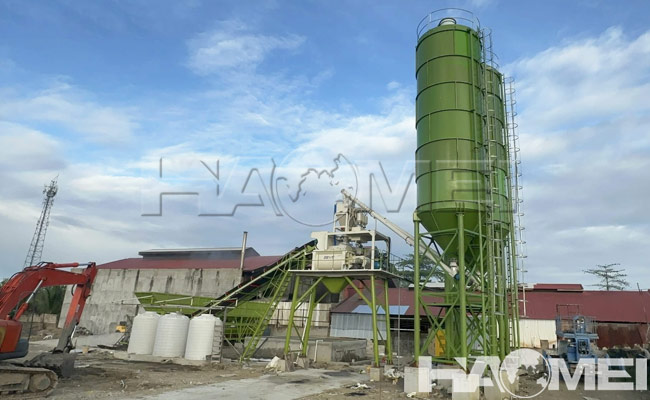
In actual project coordination, production capacity is the first core parameter we confirm with clients, and it forms the basis for precast concrete plant price. Based on mass production experience, I categorize mainstream equipment into three tiers:
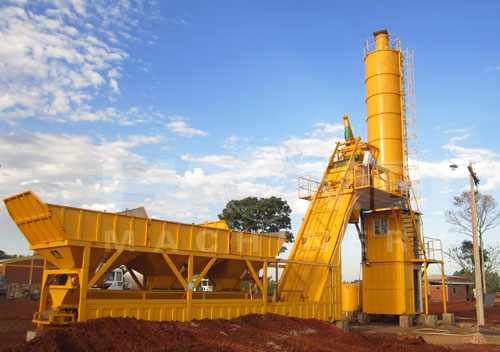
Small precast concrete plants (25-50 m³/h), emphasizing lightweight adaptability, are suitable for small precast component factories or remote projects with inconvenient transportation. The core configuration uses a single-compartment batching machine + JS1000 forced concrete mixer. After mass production optimization, the basic price can be controlled between US$35,000 and US$250,000.
Medium-sized equipment (60-120 m³/h) is currently the mainstream choice in overseas markets. For the production needs of multi-specification precast components, we standardly equip it with a dual/quadrant precision batching system and a JS2000 main concrete mixer, balancing capacity and stability, with a price range of US$68,000 to US$1,600,000.
Large equipment (above 180 m³/h) is aimed at large-scale precast concrete plant for sale, adopting a dual-machine parallel design and a high-precision intelligent batching system to meet continuous production needs, with a price range of US$1,780,000 to US$2,600,000.
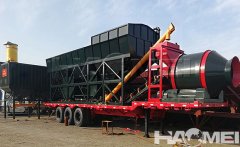
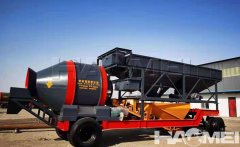
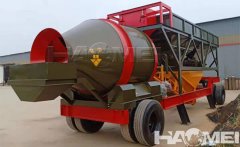
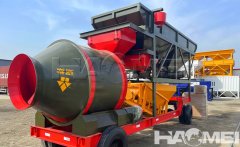
Here's a practical detail to remind customers: for the same production capacity, mobile equipment, due to its integrated chassis, hydraulic lifting, and other components suitable for outdoor operations, has higher manufacturing costs and will be 15%-20% more expensive than stationary concrete plant equipment. A rational choice should be made based on the specific work scenario.
The difference in core configuration is the key reason for the price premium of equipment with the same production capacity. This is most easily understood from a technological R&D and production perspective.
First, consider the main unit: planetary concrete mixer mixers and twin-shaft mixers are currently the mainstream models. The former, due to its more complex mixing trajectory and higher uniformity (actually measured to be up to 40%), is particularly suitable for the production of special precast concrete (such as high-strength, self-compacting concrete), but its R&D and manufacturing costs are higher, resulting in a price increase of 20%-30% compared to the latter.
Next, consider the control system, the core of equipment intelligence. A fully automatic PLC system (including remote monitoring, fault diagnosis, and data traceability functions) is $10%-$150,000 more expensive than a semi-automatic system. However, based on actual operational data, it can reduce the number of operators by 5-6. Based on average overseas labor costs, the price difference can be recovered within two years, making it a more cost-effective option in the long run.
Furthermore, environmental compliance is a mandatory requirement for overseas exports. We typically advise clients to configure pulse dust collection systems according to the standards of their target markets. Although this requires an additional investment of $20,000-$30,000, it directly meets the environmental regulations of the EU, North America, and other regions, avoiding additional costs due to compliance issues. This is a key point we emphasize to our clients in export projects.
As precast concrete plant manufacturer manufacturers, we understand that the hidden costs of overseas projects are often overlooked by clients. From a technical service perspective, it is necessary to clearly inform them of these costs. Regarding tariffs, there are significant differences between regions. Tariffs in some Southeast Asian and African countries are around 15%, while the EU's Carbon Border Tax (CBAM) can increase the carbon cost of equipment by 3%-5%, which needs to be included in the budget in advance. Transportation and installation costs typically account for 8%-12% of the total equipment price. For mountainous or remote areas, additional costs are required due to increased transportation difficulties and extended installation periods. Based on this, Haomei Machinery, through its RCEP regional capacity synergy layout, can assist clients in optimizing their supply chains and reducing some tariff costs. Simultaneously, depending on the project site conditions, we provide customized installation and training services ranging from $2,000 to $10,000 to ensure smooth equipment commissioning.
Based on years of experience in providing technical support, we offer the following practical selection suggestions for our clients: First, prioritize matching production capacity with actual needs to avoid over-investment (like using a large engine for a small project). For small projects, a basic configuration is sufficient for production, eliminating the need to pay extra for high-end features. For large-scale production, allocate 10%-15% of the budget for upgrading core components (such as the main unit and control system) to allow for future capacity increases. Second, consider long-term return on investment. Don't just focus on the initial investment. Equipment equipped with intelligent monitoring and predictive maintenance systems, while requiring higher upfront investment, can reduce failure rates by 40%, extend equipment lifespan by over 15%, and result in lower overall operating costs. Finally, we recommend clients provide detailed project parameters (such as production capacity requirements, material types, and target market compliance standards). Based on these parameters, we can provide customized configuration solutions and accurate quotes to truly achieve a balance between investment costs and operational efficiency.



 (Chat Online)


